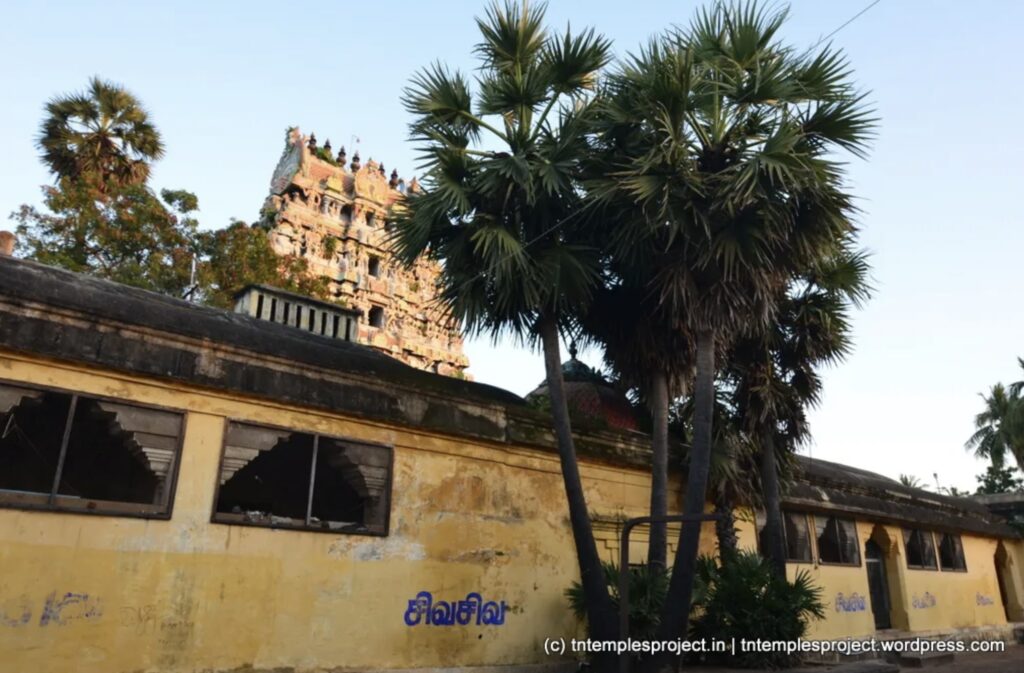
Today’s story is about Bhagawān Shiva at a place called Tiruppanandāl near Kumbakonam in Tamil Nadu. ‘Panai’ in Tamil means palm tree and since the Shivalinga was found under (tāzh) a palm tree (‘Panai’ in Tamil) the name Tiruppanandāl. The word for palm in Sanskrit is ‘Tāla vriksham’. This place where the temple is situated was thickly populated with palm trees in ancient times and hence also called ‘Tālavanēswaram’. There are two male palm trees in the Prākārā of the temple even now which you can see in the above picture.
There is the also the name ‘Tātakēswaram’ for this place.
The names for Shiva here are ‘Arunajatēswarā’ (the one whose matted locks are coloured like the rising sun), ‘Senchadayappar’ (In Tamil -Same meaning as Arunajatēswarā), ‘Tālavanēswara’ (the one residing in the forest of palm trees) and Tātakēswara’ (lord of Tātakēswaram),
The Devi is revered as ‘Brihannāyaki’ (in Sanskrit) and Periyanāyaki (in Tamil)
There are many legends associated with this temple. It is believed that Parvati Devi was initiated into sacred knowledge here by Shiva. Brahma was forgiven for lying to Vishnu during the incident of Lingodbhava after he prayed here ( the story of Lingodbhava is here). Indra, was absolved of the sins of killing Vritrasura and that of cheating Rishi Gautama after he prayed here. Surya, when he offered prayers here, was forgiven for his act of colluding against Bhagwān Shiva at Dakshā’s ‘Yagna’.
There is also an interesting reference of the Naga Vasuki not being able to find a suitable match for his daughter Sumati when Shiva appeared in Sumati’s dream and asked her to go to Tālavanēswaram and worship Him. Sumati came through an underground cave and prayed here and got a suitable husband in prince Haridhwaja and lived happily. Rishi Agastya, Airavata and Adisesha are said to have prayed here. The list goes on and on…
I have chosen to narrate two of the legends here. The first one relates to how the name ‘Tātakēswaram’ came about.
Thousands of years ago there was a woman by name Tātakā (not to be confused with the Tātakā of Ramayana). She did not have a child and therefore prayed to Brahma. Brahma told her to go and propitiate Arunajatēswara at Tiruppanandāl. Accordingly she came to this place and worshipped Shiva with great devotion, every single day. She would perform an elaborate Pūjā with sixteen types of offerings to the Deity.
One day during the Pūjā, when offering the garland, when she lifted the garland with her two hands to place it around the Shivalinga, her upper garment slipped. She could not put the garland down as she felt that once it was to be offered to Shiva, it should not be kept down. She tried to prevent her garment from slipping further by holding it in between her elbows. Filled with embarrassment and distress that the worship was obstructed she stood not knowing what to do.
Seeing her predicament the benevolent Shiva in the form of the Linga bent in front of her making it easy for Tātakā to place the garland around Him without letting her garment slip. Extremely grateful for this gesture, a teary eyed Tātakā thanked Bhagwān Shiva and prayed that she be granted what she had yearned for all along – a child. Shiva in His resplendent form appeared before her on His Rishabha Vāhana. In addition to granting her wish, He blessed her with sixteen hands to offer the sixteen types of offerings. Tātakā further requested that for people to remember this act of compassion of Bhagwān Shiva to her, this place be known as Tātakēswaram taking her name. From then on this place got its name ‘Tātakēswaram’.
Now comes the second legend.
Many centuries passed. The Linga in the temple was bent and in the same slanting position. There was a king by name Veerasēnā in the Chola dynasty. He came to know of the greatness of this place. When he visited the temple, found the Linga in a slanting position bent forward. He wished to ‘straighten’ the Linga. With the help of many elephants with ropes tied to the Linga, he tried his level best. The Linga, however, did not budge even an inch!
During this time, Kunguliyakalaya Nāyanār lived nearby at Tirukkadaiyur. (You can read the story of this Nāyanār here). He came to know of the king’s efforts and rushed to Tiruppanandāl. He was distressed at the sight of elephants tugging at the rough coir rope which was tied to the Lingam. He requested the king to stop the effort immediately and that he would try. The king agreed.
Nāyanār removed the coir rope and replaced it with a sturdy cotton rope. One side of the rope was around the middle portion of the bent Lingam. The other end was tied to his neck in which he fastened a sharp knife. Praying fervently to Shiva to come back to His original position and chanting the ‘Panchākshara Mantra’ Nāyanār started pulling the rope from the opposite side. The knife fastened on the rope on his neck started slicing the skin and blood oozed out. The more and more he pulled the more and more of his neck was getting cut.
Nāyanār was unperturbed and continued pulling the rope chanting Bhagwān’s name all the while with utmost devotion.
As the people around were witnessing this with fear, awe and amazement, a hand suddenly appeared from the Linga and extended to touch Kunguliyakalayar. Lo! and behold, the Linga had become straight and there was no trace of blood on Nāyanār’s neck. Bhagwān Shiva could not bear the pain of his devotee and had acceded to his request and become straight. And Nāyanār’s neck had healed completely!
Kunguliyakalayar, overflowing with bliss by the divine touch of the Lord, broke into ecstatic chanting of the Panchākshara Mantra aloud. The crowd chanted with him. The king was extremely happy that the Linga had come back to its normal position. It has been in a straight position since then.
The first granite structure of this temple is said to have been built by a resident of Tiruppanandāl by name Nakkan Tharani. Rajaraja II who lived in the later twelfth century renovated the temple. There is a separate shrine for Kunguliyakalaya Nayanar in this temple.
Let us all pray to Tālavanēswara and Brihannāyaki seeking their blessings on this Mahāshivarātri!!
Shambho Mahadeva!
Note: Shri Kumaragurupara Swamigal’s successor opened the ‘Kashi Matam’ at this very place. You can read the story of Shri Kumaragurupara Swamigal here.
Sripriya Ramesh
Superb writing Vidhya. You are so good. Enlightening us with your lovely unheard of sthala puranas and so many others. Needs a lot of reading and sincere attention to details. Your passion comes through in your writing. Brilliant. Keep at it. Your good work educates us. Congratulations and thanks much Vidhya.
krvidhyaa
Thank you for your feedback Sripriya! Thanks for reading.
Latha Rajagopal
lovely story vidhya. keep writing.
krvidhyaa
Thank you Latha!
GIRIJA N
Really exhilarating to read this Purana on MahaShivarathiri today. Your writing is enlightening. Lucid language and easy flowing.
krvidhyaa
Thank you Girija for your feedback!
Gomathi S
Very happy to read the story on the day of Shivaratri. Thank you Vidhya 😊😊
krvidhyaa
Thank you Goma!
Pamela
Very well narrated .. Hara Hara Mahadev 🙏🏼
krvidhyaa
Thank you Pamela Ji!
Viji Gopi
Delighted reading this Vidhya. The free flowing narrative made it so very enjoyable. keep writing. our children need this
krvidhyaa
Thank you Ji!
Ram Mohan Narasimhan
Very nice story and narrated well. I had heard the first story when I was a child and hence brings back nostalgic memories.
krvidhyaa
Thank you Ram Mohan!