As per our Indian calendar, we are in the middle of the Adhika Māsa which is from 17th May 2026 to 15th June 2026. Adhika means ‘extra’ and Māsa is ‘month’.
What is this ‘extra month’ and its story and scientific explanation?
The story is mentioned in our Purānās. There is also reference to Adhika Māsa by Bhīshma Pitāmaha in the Mahābhāratha.The scientific explanation is also given after the story here.
A year has twelve months be it the Indian calendar or the Gregorian calendar. In the Indian Calendar each of the twelve months are ruled by different deities.
However, long long ago, providence gave birth to an additional month adding it to the existing twelve months.
When the thirteenth month was born, the human beings and demi-gods looked at the month with disdain. The month did not have a name nor did it have a ruling deity. Further it had two New Moon days which was strange. Hence people rejected the month and called it ‘Mala Māsa’. Mala refers to waste including faecal waste. Nobody was willing to conduct any festivals / auspicious events in the month.
This constant bad-mouthing by the human beings and demi-gods hurt the entity of the month deeply. She (the month) went to Bhagwan Mahavishnu and fell at His feetncrying uncontrollably.
“Hey Karunā Sāgara!” She said, “I have been abused by all the people of the world and the demi-gods for no fault of mine. I have neither a name nor a protector like the other months. I have been mocked as ‘Mala Māsa’ and I have been ostracised and rejected as ineligible for conducting any auspicious activities. I have no saviour and I feel extremely miserable. I seek your Lotus Feet for solace. Hey Janārdhana! Please grant me asylum else I wish to perish!”. Saying so, She fainted and fell at Bhagwan Vishnu’s feet.
Garuda the Vāhana of Vishnu fanned her gently with his huge wings following which She got up. But She was still unconsolable as Vishnu had not responded to her plea. “Please, please show me mercy. Please do not betray me Bhagawan!” She sobbed pitifully.
Mahavishnu smiled. “Do not cry after seeking asylum with me” said He reassuring Her. “Do not worry that you do not have a name or protector. I give you my name from now on. You will be known as Purushottama Māsa and I will be your protector”. She (the month) was greatly relieved and pleasantly shocked that Bhagwan Vishnu himself would be her protector and she would go under His very name.
Mahavishnu continued. “I shall make you equal to me in fame and in importance. And since I am bestowing all my divinity on you, you will become worthy of worship by one and all. All the beings of this world who seek sensory gratification all the time will make use of you to perform austerities and pious deeds and charities which will benefit humanity. And by performing such deeds in that one month, their merits will be amplified a number of times and they are sure to reach my abode after their sojourn on earth”.
The abused ‘Mala Māsa’ had now been transformed to become the esteemed ‘Purushottama Māsa’ by the benevolence of Mahavishnu. The month was greatly delighted by the words of Mahavishnu and from then on, the thirteenth month came to be called as Purushottama Māsa. And this is the Adhika Māsa we are in right now.
Now let us understand the science behind the Adhika Māsa. For that we have to look at the calendars followed in our Indian system.
The months in the Gregorian calendar have random number of days. Indian calendars on the other hand are based on the movements of celestial bodies These are the solar calendar and the lunar calendar.
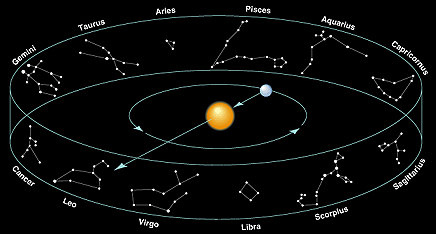
The solar calendar is based on the annual cycle of the Sun – Month is reckoned when the Sun appears (from earth) to have ‘moved’ into a constellation. The Sun ‘stays’ in the constellation for thirty odd days before moving into the next constellation. This is a Solar month. The following image shows the Sun appearing against the constellation Leo. As the earth moves, the Sun also seems to move to the next constellation and this movement is called a ‘Sankranthi’
The lunar calendar on the other hand, is based on the cycles of the moon – Month starts on the day following Amavasya and ends on the following Amavasya (called Amānta calendar). In some regions it is from Purnima to Purnima (called Pūrnimānta calendar) However, both are based only on the Moon’s phases.
It is to be noted that the names of the months are the same both in the Solar and Lunar Calendars (starting from Chaitra to Phalguna or Chittirai to Panguni) barring few variations.
While many states of Bharat follow any one of the above Lunar calendars, states like Tamil Nadu, Kerala, Tripura, Assam and Bengal follow the Solar calendars so that the farming activities / seasons align with the solar cycle.
However they do use the Lunar calendar for determining the dates of the festivals or cultural events which are not dependant on the solar cycle.
This method of combining both solar and lunar calendars give it the name ‘Lunisolar calendar’. By doing this the solar and lunar cycles are harmonised so that festivals and seasons align in the long run.
The Lunar year consists of 354 days made of 12 Lunar months. But the Lunar month is lesser than the Solar month since the number of days in a lunar month is the number of days the moon takes to go around the earth such that it comes to the same position with respect to the Sun (even after the Earth moving along its orbit).
The solar calendar’s month aligns with the Earth’s orbiting around the Sun and is 365.25 days. Hence there is a difference of about eleven days between the Solar and Lunar calendars.
If this difference is not ‘adjusted’, the Lunar calendar will go completely out of sync with the solar seasons. For example, Dīpāvali is celebrated after the monsoon season just before winter on the fourteenth night of the waning moon of the Aswina or Aippasi month. If the calendars are not aligned periodically, the Lunar month of Aswina would be advanced and Dīpāvali may happen in the month of September or even before that. Same is the case for all festivals.
Adjusting or adding a month is a similar situation like adding a day in the leap year. But our sages did not manually add an intercalary month. Instead they observed a particular celestial phenomenon. What was that??
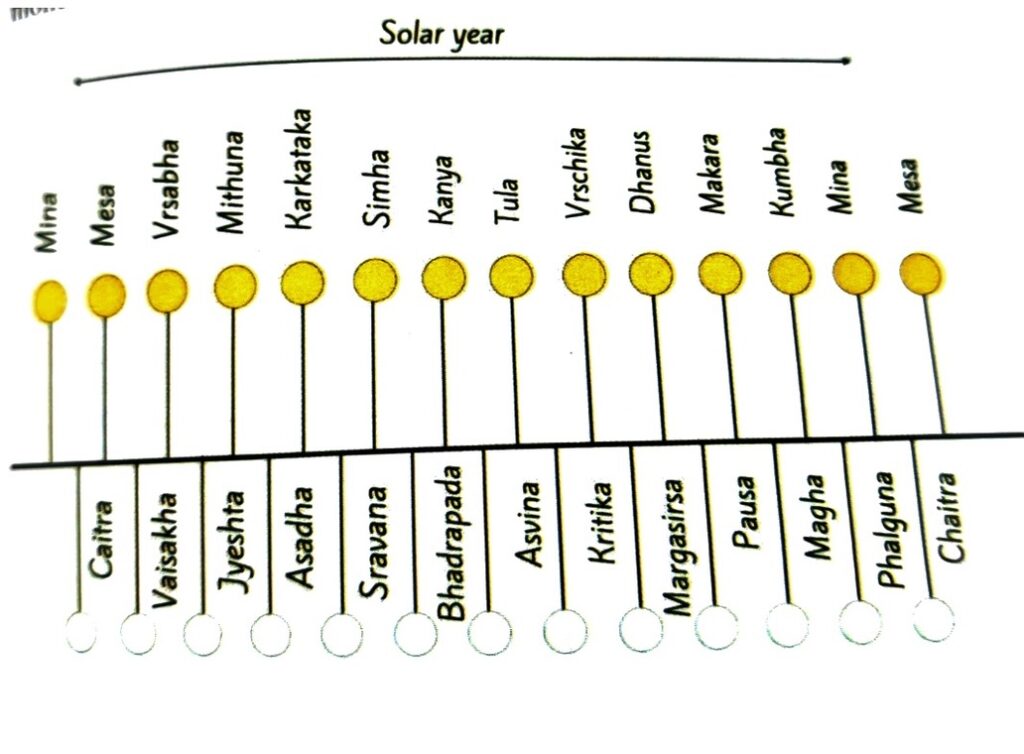
The ‘Sankranti’ of the Sun usually happens between the interval of two new moon days in a normal lunar year (which is generally shorter than the solar year). You can see the diagram below. The yellow rounds denote the solar months and names of the constellations the Sun is in is given. The white ones denote the lunar months starting on the day after Amāvāsya (New Moon). Thie diagram shows that the movement of the Sun from one zodiac to another happens in between two New Moons
Diagram of Normal year:
Is it like this all the time? No.
Due to the elliptic orbit of both the earth and the moon, at one particular point of time, the ‘Sankranthi’ of the Sun takes longer time to happen when observed from earth.
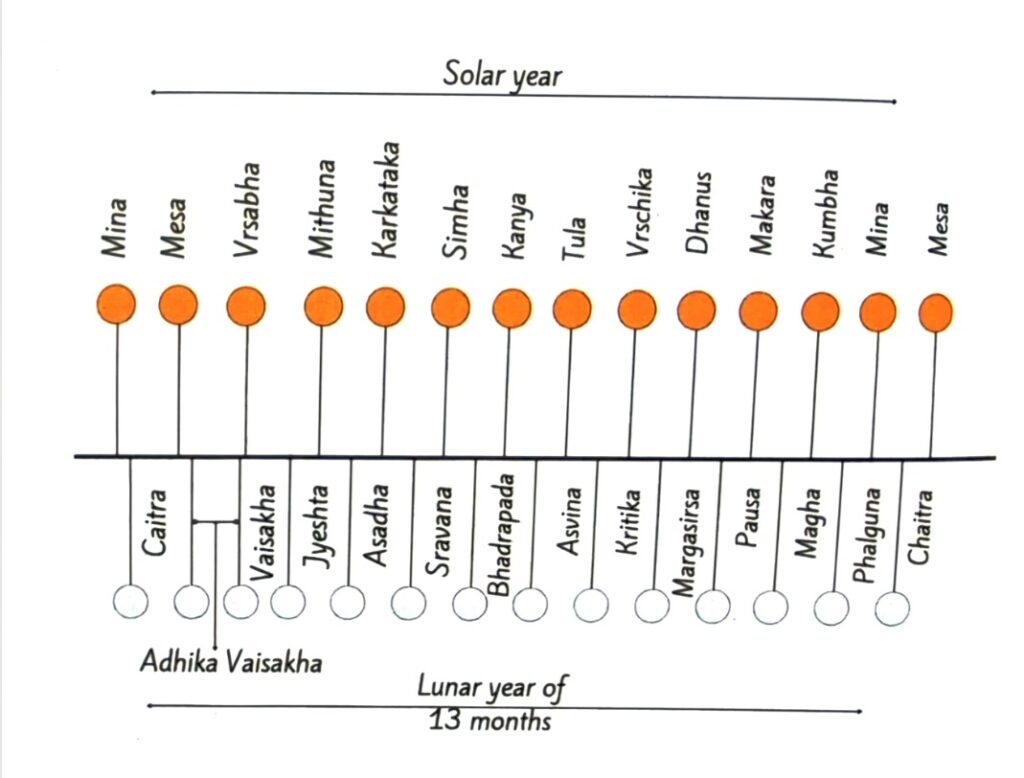
During this phenomenon, the Sun does not ‘move’ to the next Rashi between two successive new moons. One transit happens before the New Moon as usual and another happens after the next New Moon. In that situation, the solar month has two New Moons and the Lunar month has no ‘Sankranthi’ within it. So the lunar year ends up having 13 months instead of 12. This month is called ‘Adhika Māsa’ or extra month.
You can see this in the diagram here. The month of Vaishaka is on now and we have an ‘Adhika Vaisakha’ as well. Two New Moons have happened within the solar month of Vaisakha.
Diagram with Adhika Māsa:
This is a natural phenomenon which happens after every 2 years and 8 months. This was the phenomenon noted by the Rishis and was used for the adjustment of the two calendars.
Since there is no ‘movement’ of the Sun, the month was considered inauspicious and so goes the story. And after Bhagawan Mahavishnu gave her(the month) His name, this month, called the Purushōttama Māsa is used for spiritual purification and contemplation. Routine auspicious functions of weddings and house warming ceremonies are not conducted in this month. The fruits of doing spiritual activities in this month has been lauded in many Puranas and scriptures.
And with that we come to the end of the story of Adhika Māsa. The present Adhika masa exists until June 16th.
Interesting facts :
- Chinese Calendar, Hebrew Calendar and certain other ancient calendars are also Lunisolar in nature.
- In the current Gregorian calendar we follow, to ‘adjust’ the discrepancy between the date and the season(equinox) in particular, ten days were cut in the calendar of October 1582 CE. October 4, Thursday was followed by October 15, Friday!
Note:
Science content reference and Picture credit: anaadi.org/iksbooks
Vidya @ Manomayi
Excellent narration dear Vidhya! Kudos.,.. for your dedication and enthusiasm! 👏💯 God bless you! 🙏❤️🎉🎊
krvidhyaa
Thank you Vidya!
Sripriya Ramesh
Lovely Vidhya. Adika or Purushottama maasa story very nicely written. Also the science that goes with the maasa. Congratulations and tha n ks much.
krvidhyaa
Thank you Sripriya!
mohan revadi
Thank you Vidya for excellent explanation of Purushottam Masa. It shows the true greatness, wisdom and knowledge of our ancient sages.
krvidhyaa
Thank you Mohan!
Gomathi S
An excellent attempt to explain the Adhika Masa through story and science. I think I have understood. Will keep referring it when needed.
Keep doing the great work Vidhya. My best wishes 😊😊
krvidhyaa
Thank you Goma!
Lalithambal Natarajan
very well narrated Vidya.. I have been getting Haldi Kum kum this month as a part celebrating Adhik mas. As we are in a cosmopolitan society it is very common to observe people following all three calenders… sometimes Amavasya calender people are busy in temple with the commencement of Shravan while purnima based calender people wait for it… your writting explains all these things
krvidhyaa
Thank you Akka! I was apprehensive that it may be too complicated. Thanks for reading and giving feedback!